Jamie Stantonian is a creative technologist and writer exploring humanity’s long coevolution with information technology—from the Paleolithic to the Pyrocene—across essays, video, painting, and generative art. His work examines this evolving symbiotic relationship as a way of making sense of today’s planetary-scale systems of meaning-making. In 2023, he trained with the McLuhan Institute to deepen his understanding of how media shapes human perception, particularly in the context of emerging technologies such as AI. He is co-host of the Long Now London community, and his writing can be found on Substack at The Resonant Interval.
Artist Statement
My work grows out of two intertwined obsessions; the deep time of the living world, and the role technology has played—and continues to play—in that unfolding story. The instrumental power and economic potential of today’s industrial and computational media is well understood. Less explored is how media transform our cognitive processes and collective sensorium at a mass scale, not only electronic media, but every media, reaching back to the dawn of our species. These questions drew me to human evolution and archaeogenetics, alongside media ecology and the work of Marshall McLuhan, and led me to study with the McLuhan Institute in 2023.
I have explored these interests through essays, documentaries and imagined cultural histories of fictional peoples. My early experiments ranged from glitch art and digital painting to attempts to recreate archaic forms, painting fragments of wood and bark with ochre. In the early 2020s, I began exploring generative AI, initially by recreating the VHS cover art I made as a child—a way of examining how media had shaped my own nascent imagination. This then moved to more significant explorations of the potential of generative media. Over the past decade, I have exhibited widely in London and spoken about these themes at the Saatchi Gallery, Hundred Years Gallery and Black’s Club in Soho.
About The City Remains
My earlier AI work embraced the medium’s unpredictability. Drawing on methods from glitch art, I used prompts to provoke and confuse models, generating unexpected images that I could shape towards my own intentions. Newer techniques offer more direct control, allowing hand-drawn images to guide the output.
Since I first owned a smartphone—an iPhone 3G—it has appeared in my dreams as a tool for trying, fruitlessly, to capture what I see before waking. With these newer techniques, I realised I could, in a sense, photograph dreams: combining drawings with lyrical prompts, then bringing the resulting images to life through video.
I have kept a dream journal, on and off, for more than twenty years. Over that time, I have mapped a world of sorts: my home city of Edinburgh, recalled and reconfigured in its strange, oneiric dimensions. Using Perplexity to interpret these dreams through the complete works of Jung, I began writing a narrative that moved through the regions of this unconscious world, taking me in directions I had not anticipated.
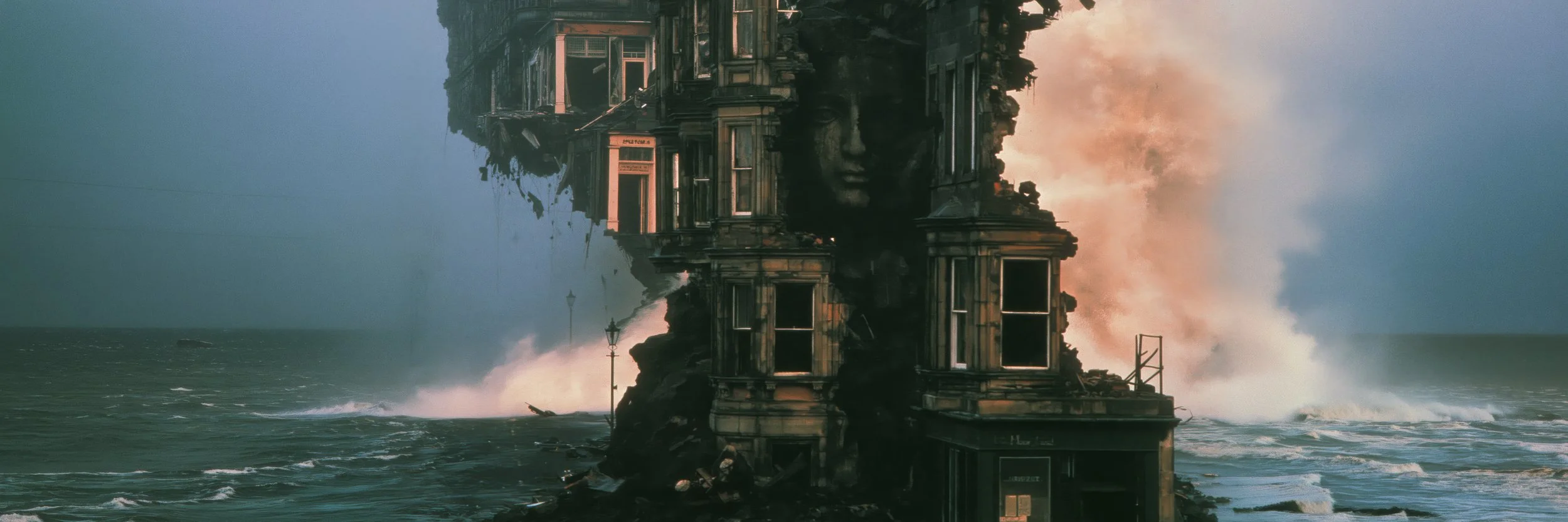
In The City Remains, Edinburgh becomes an immense psychic landscape: part memory, part myth, part living organism. Familiar streets unfold into labyrinths; volcanic hills rise and fall with hidden emotional forces. Architecture is buried, excavated and rebuilt from the strata of personal and ancestral memory. The journey leads towards the city’s sacred heart, where impossible landscapes speak from the cosmic night of the psyche.
Combining hand-drawn art direction with AI image generation and animation, this experimental film explores new possibilities for filmmaking while keeping human imagination and personal expression at its heart.
Hello, World!